Another Bites the Grinds
or: Is Starbucks Really the Antichrist? A story of big coffee's affect on the little guys.

NYC. Mid-2000s.
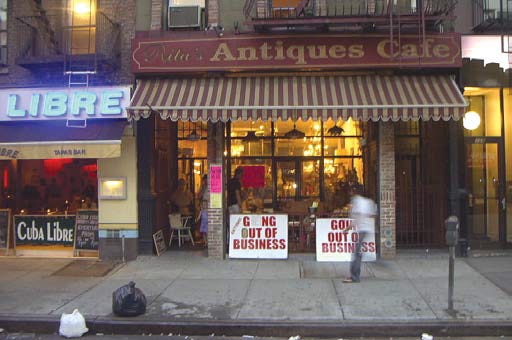
Aysha is pissed. The girlish 29-year-old is the manager of Rita’s Antiques Cafe on 8th Avenue in New York City’s Chelsea neighborhood. Her chalkboard out front was once covered with happy stories and daily specials, but it now rambles with dark fables. This evening’s allegory is of a father and son being eaten by sharks with the motto: LIFE ISN’T FAIR!!!”
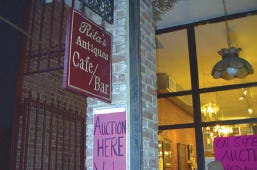
She markers the “Clearance” sign so that it reads “Going Out of Business—50% Off Everything.” Eyebrows raise and necks crane on the faces of neighborhood folk with high disposable incomes. There are many designers and antique hunters in this part of town, and people like a good deal.
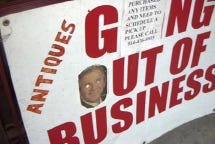
A woman standing beside me with a stroller stares through the window. I ask what she thinks of the place closing down. “I’m thinking maybe I should run back to Starbucks and tell my husband. Fifty percent on everything? Maybe they’ll go even lower, right?”
I shrug. Maybe.
--
Running a small business translates into a lot of hours. Many owners dream about their stores, making them essentially 24-hour-a-day ventures. They know which vendors will extend their credit, which customers are trouble and other entrepreneurial essentials. They also know where anchor bolts can be placed, which electrical wiring needs redoing and what makes the toilet overflow. It’s all-consuming.
“But the pride of showing off what you can do, to every customer who walks in the door, is worth it,” says Aysha. “Was worth it,” she corrects herself, as she returns to Earth with a thud. This is, after all, a moment of defeat. She can’t convey the emotion that goes with people smiling at half-priced claw-foot tables. During our interview I feel horrible to find my eyes drifting repeatedly to a tiger oak Arts & Crafts-era mirror.
Eureka Joe’s, Chelsea Espresso Bar and, as of July 30th, Rita’s have all closed in Chelsea, leaving only three other independent coffeehouses open: Big Cup, Chelsea Coffee Company and The Matchbox. With skyrocketing rents and Starbucks shops opening literally across the street from one another, it remains to be seen which will last and for how long.
Does anybody care? Should they? Can anything stop them from closing?
I interviewed eight coffee industry sources and asked what they thought was causing independents to close. Surprisingly, publicly-traded coffeehouses were not first on their list of demons. More amazingly, statistics are showing that large chain coffee retailers actually help independents’ business improve nationwide. New York City may be the anomaly, however, with an overwhelming number of those large retailers.
Aysha says that rents were the primary problem for her business. $30,000 per month isn’t easy to come up with, unless you’re doing a few thousand each day, which is uncommon for a small café. Even if it were once feasible, she concedes it’s less likely to happen daily with at least 10 (count ‘em: ten) Starbucks in a 10-block radius of her.
Max, a manager at Big Cup, on 8th Avenue, thinks too much of any competition makes it impossible to survive. “There are just too many places in too small an area,” he says. “It doesn’t matter if it’s Starbucks or the Chelsea Coffee Company, stores are going to close.”
Paul Shaytin, heir to the Empire Coffee and Tea Company, which has been in his family since 1908, has a different take on things.
“There has to be a need,” he says in a telephone interview. “The need we fill is supplying high-end wholesale beans to businesses. We could shut down our retail stores and do just fine.” I’m surprised to find Shaytin going easy on Starbucks, too. “Starbucks is not vicious. They’re not predatory. They’re not like the drug-store chains that shut down the Mom-and-Pop pharmacies and then shut down their own less successful stores just to destroy the competition. Virtually all their stores do stay open, so I feel a little less bad about that aspect of it.”
“In other words, it’s just business. Nuthin’ personal?” I say in a bad Sopranos accent.
“Exactly.”
--
I agree with Shaytin. There has to be a need for your business, or so I found out, having owned an independent coffeehouse for 10 years. Jeremy’s Cybercafe & Beer Haus was in Joshua Tree, Calif., where you see all those funny crooked desert trees in the movies and SUV commercials. It’s actually still there, run by its fourth owner1 under yet another name, but it refuses to go away because it fulfills a need. I opened it in 1991 as a hangout for rock climbers in one of the world’s most popular climbing areas. All the video and film shoots certainly didn’t hurt business. Neither did the Marines from nearby Twentynine Palms, the largest ground-based military installation in the world and, since the Second World War, a major training ground for desert warfare. Rents were low and there was no competition. The area had never even seen a functioning commercial espresso machine.
People saw that the business worked and there were soon 14 commercial espresso machines in the area. But to prove Max and Shaytin’s points, only three remained when I sold the business in 2000. Too many cafés, not enough need.
My interviews went national when I called Cappuccino Gardens in Spicer, Minn. to see how things fared in the Midwest. Katrina Pawlaczyk, the proprietor, was owner number three of my old café, before selling and moving back closer to her home town. Lorrina Grabhorn, her partner, says, “It’s not enough to want to own a café. We have a lot of competition, so we look at what they do, and we do the opposite. They all stick in a leather sofa and a fireplace and wait for the money to come pouring in. We’re busy with open mics, all-you-can-eat pasta, catering and parties. They use the latest creation from Sysco, whereas we won’t use anything unless it’s fresh, fresh, fresh.”
Her passion pours through the phone, or maybe it’s the caffeine. She highlights a recurring theme, that a balance between good business plans and passion is required to achieve success in specialty coffee retail. The more of both, the better. Grabhorn says, “We’re cooks who love to cook, that’s why we make it.”
Her nearest competition in Spicer, a town of fewer that 1200 inhabitants, is only a quarter-mile away, with a number of other cafés not much farther off. But none of them are going under. I ask how many Starbucks there are in the area. “Not a one,” says Grabhorn. “Soon as one opens, we might be the only independent that survives.” She thinks Starbucks has a far more negative impact on the independents than the forgiving New York owners.
But Lara Wyss, a spokeswoman from Starbucks, disagrees. After we spoke on the phone she e-mailed me an October 2002 Wall Street Journal article that shows business goes up for independents when a Starbucks opens nearby. Wyss encouraged me to speak with another spokesperson who also supports the claim that Starbucks helps independents. Mike Ferguson is the chief communications officer for the Specialty Coffee Association of America (SCAA) in Long Beach, Calif. Not exactly a mermaid flack.
Me: “Mike, are you capable of criticizing Starbucks, or is your relationship such that this is an impossibility?”
Mike: “I’d rather not criticize them. They are a member in good standing of our association, but I wouldn’t favor them over another member if that helps any.”
Me: “Fair enough. Let’s talk in hypotheticals.”
Mike: “Okay.”
Me: “Is Starbucks the Antichrist?”
Mike: “Excuse me?”
Me: “Must be a bad connection—what I said was: ‘has the time has come for the small coffeehouse to shut down and make room for more Starbucks?’”
Mike: “I don’t think so. I can’t speak for New York City, but nationwide the bottom line shows business going up for independents by Starbucks moving in. It shows as many independents opening as chains. Nationwide, people are more interested in specialty coffee drinks, which is good for everyone. Starbucks forces the small business owner to rise to the occasion and improve his business to compete. This also increases interest in good coffee drinks for that particular area. If the small owner does rise to the occasion, the improvements are noticed by regulars, and are appealing to first-time customers as well.”
Me: “And the small cafés that go under?”
Mike: “We’re finding they were either good businesspeople who were not passionate about their products, or people who were passionate, but not good businesspeople.”
The one person I interviewed who agrees a Starbucks next door helped her business was Bobbie House, owner of Landmark Coffee in Hoboken, N.J. She won’t reveal exact numbers, but says her sales went down at first, then swung right back up beyond her baseline. “Fortunately we were established for five years before they came, in 1998, so we could ride out the storm. But in the end, people think of our little area as the place to go for coffee, be it Starbucks or us, the mom-and-pop. Some people do have the ‘Walmart mentality’ and prefer Starbucks, but others notice we’re actually less expensive for the same thing. We have to thank them for drumming up business on the higher-priced drinks and charging so much for them.”
During my interview with Lara Wyss of Starbucks, some of her responses make perfect sense. She responds to my asking why people will pay more to go to a corporate-owned café: “Students and travelers pursue Starbucks for wireless net connections.” Other bits are harder to fathom: “Starbucks open across the street from each other because people don’t want to change their routine by having to cross the street to get a coffee. It’s also to accommodate traffic if there’s a long line at one store.”
I asked Bobbie House, the independent cafe owner, if she planned to open a Landmark Coffee across the street from herself anytime soon. “That’s absurd,” she said. I asked why. “I think they’re opening everywhere because they can afford to. Some make a lot of money, some make a little, but overall it’s profitable. They cover large areas trying to shut down the little guys.” I remind her the point of our interview is that her business improved. “Yes, well, it’s still absurd,” she says, “opening across the street from yourself.”
Before I sold my business, I was offered an opportunity to open a second café in the next town over from Joshua Tree, in 29 Palms, but business veterans advised that I’d be competing with myself. Apparently this isn’t the case for Starbucks, as evidenced by the lack of their shops closing, no matter how many they squeeze into a neighborhood.
Without going into the Starbucks pullout from Israel due to security concerns, I asked Lara Wyss if their stores ever go under. “They do,” she says. “Generally it’s because of a lease expiring or our finding a better location in the same area.” So not because of a lack of business. We discuss Starbucks in the movies (Austin Powers, Best in Show) and I mention Janeane Garafalo’s Starbucks material. Lara hasn’t heard it.
So I tell her, “It’s something to the effect of, ‘I came home the other day and they had opened a Starbucks in my living room. You’d think they’d need a permit or something.’”
Wyss says, “That’s funny.” But she isn’t laughing. After a pause, she continues, “Y’know, a lot of people would like a Starbucks in their living room.” With 8000 stores in 34 countries serving 30,000,000 drinks each week,2 she’s probably right.
I’m trying to fight the good fight and prove Starbucks must be shutting down our beloved independent cafés, but there’s little supporting evidence to prove it. Flummoxed and not knowing where to go with my interview with Wyss, I scrape the bottom of the interview barrel by asking what new products they have coming out. I let her tell me about the Frappuccino Light, which has 30-percent fewer calories, without the whipped cream.
After concluding the call, I step out my door and walk (I counted) 50 paces to the nearest Starbucks and try the new drink she mentioned. I feel really lousy admitting it’s not bad. It’s so not bad that I start getting one every day, and of course I feel just terrible about it. Every time I sip my yummy beverage I fear I’m sucking the life out of a small café somewhere, owned by an aging hippie without a clue, but who does possess a lame open-mic night full of angst-ridden teenage poets who will soon have no place to pour their hearts out. I love those places and those owners. Hell, I was one for a quarter of my life! I wonder where my niece, Zoë, will one day play. She just turned 11 and will soon be ready to show off her original songs. Perhaps those old cafés with $500-a-month, 30-year leases will be around long enough for her to perform at their open mic nights. I do hope the others wake up and smell the business-minded coffee before it’s too late and a Starbucks moves in.
It’s sad that times have changed, but there’s not a lot we can do about it. It’s up to the owners to keep it fresh, which isn’t easy to do after 10 long years. It’s up to them to give the masses a reason to walk the extra five blocks, passing Starbucks after Starbucks along the way. If they don’t, well, we’ve adapted to the loss of indie movie theaters, fair elections, Seinfeld and Friends,3 for better or worse we can get through this, too.
I sip on my blended mocha thing (I can at least refuse to use their ickie Starbucks product marketing language, except where required by an editor) and wonder if I could adapt to Starbucks being, in their lingo, my “third location between home and work.” I want to think my “gathering point” should have real character, not be a corporate mock-up. Rita’s was my hangout, right around the corner from my apartment, and it will be missed, as will Aysha.
I’m pretty bummed about it, but still, sipping my low-cal drink, I have to admit that the tiger oak Arts & Crafts mirror looks really good in my living room.
<End>
Fiften owner now, operating as Radio Free Joshua Tree, unfortunately all the murals have been painted over, but Teddy is doing very cool stuff with the place.
Very outdated figures from 20 or more years ago.
Holy shit, these references are outdates since the early-mid 2000s.